


Last week I stood in front of three tapestries at The Met, each more than fifteen feet tall, and woven from Raphael’s original designs decades after his death. It got me thinking about how AI fundamentally inverts the economic problem copyright law was built to solve.
The Raphael: Sublime Poetry exhibit culminates with the replicas of three of Raphael’s famous tapestries and their fascinating story. Soon after his election in 1513, Pope Leo X set Raphael to design a series of ten tapestries for the Sistine Chapel, the Acts of the Apostles, to hang below Michelangelo’s ceiling. Raphael and his workshop spent 1515 and 1516 painting the full-scale cartoons, the working designs, on pasted sheets of paper, detailed enough to be turned into wool, silk, and metal thread. Seeing the drawings and preparatory studies displayed at the exhibit is a small sample of the herculean effort. Before weaving, they would be rendered in reverse, because the loom would flip them.

Raphael was paid about a thousand ducats for the designs. The weaving in Pieter van Aelst’s Brussels workshop cost around fifteen thousand more, enough that Leo’s spending left the papal treasury in debt by the time he died.
That is the cost of the first tapestries, one that almost bankrupted the famously profligate Pope Leo X.
A few rooms on, the exhibit hangs three of those tapestries, woven not for the Vatican but for Philip II of Spain in the late 1540s or early 1550s, a generation after Raphael’s death, from a second weaving of his designs by Jan van Tieghem and Frans Gheteels. The three — The Miraculous Draught of Fishes, Christ’s Charge to Peter, and Paul and Barnabas at Lystra — are on loan from the Spanish royal collection and had never been shown outside Madrid until now. The original cartoons Raphael’s own hand had worked were not there, since the surviving ones have hung in London at the Victoria and Albert for over a century, but these were woven from the same compositions. Three exquisite tapestries, but copies of Raphael’s original design.
Standing in front of these tapestries, I saw why copyright law wasn’t needed to protect Raphael. These tapestries were cheaper than the first set, because the design had already been done and paid for. But they were not cheap. Reproducing the work meant another team of weavers, another loom, another year, another fortune in thread. When the only way to copy a thing was to make it again almost from scratch, with enormous human effort and mastery over the loom, the copy cost nearly as much as the original. No one needed a law to stop it, because it was prohibitively expensive. In fact, only the most extraordinary works of art would be replicated because of the cost, and it made more sense to credit the master to justify the expense. The value of these tapestries increased by crediting Raphael, not denying him.
Copyright became necessary only when replication got cheap, when the printing press and the engraving could throw off a Raphael composition for the cost of paper and ink. It is with these changes in technology that the first original effort needed protection.
AI is another technological disruption, but instead of making copying cheaper, it makes the first expression cheaper.
Expression, not Ideas
Copyright protects the way something is written, drawn, or sung, but not the inherent idea that is expressed. One can own one’s sentences. No one can own the broader point made by their sentence. If written today, “To be, or not to be, that is the question” would be protected by copyright. But Hamlet’s core story – a young prince whose father, the king, is murdered by a treacherous uncle who seizes the throne, until the prince returns to avenge his father and reclaim what was taken – is not protected by copyright. Which is just as well because it is also the story of The Lion King.
The reason the law is designed this way is that writing something original the first time is expensive and copying it afterward is cheaper. If the law let anyone sell copies the moment a book appeared, the price would fall to the cost of copying and the author would never earn back the cost of writing, so the book would not get written. Copyright solves this by giving the author a monopoly over copies for a limited time, which holds the price high enough, for long enough, to pay for the first original effort. Protect the expression and writing can be compensated. Protect the idea and most writing becomes impossible. Copyright law trades off between those two, protecting the words, and therefore the effort, and freeing the idea.
When copying was expensive, copyright protection was not required. Technological changes made it necessary.
The first modern copyright law, the Statute of Anne, passed in England in 1710 under the title of an act for the encouragement of learning, set the shape every system since has kept. It gave the author the sole right to print a work for a limited term, the famous fourteen years renewable once, and then let the work fall to everybody. A monopoly over copies, held long enough to pay for the first effort, incentivizes that effort of writing. There is a matching danger on the other side. If the monopoly reached the idea and not only the words, every later writer would also need a license to use the idea. But almost everything that gets written is made out of ideas taken from somewhere else. Protect the expression and writing pays for itself. Protect the idea and writing is shackled.
What did the courts protect?
For centuries the courts have argued over where the line between idea and expression falls, and they have placed the idea on the free side again and again, even when the idea was expensive to generate. In 1879 the United States Supreme Court decided Baker v. Selden setting the tone for copyright protection. Charles Selden had published a book setting out a bookkeeping system, a method of condensing a firm’s accounts onto a single page. A competitor named Baker used the same system with the columns rearranged. Justice Bradley, writing for the Court, let Selden keep his version of the book and freed the idea/system of bookkeeping. Anyone could keep accounts Selden’s way, because the method was an idea and ideas are open to all, while the particular pages Selden had written to explain it were expression and his alone. He owned the way he taught the system of bookkeeping. He did not own the system of bookkeeping. For that, he would need a patent.
In 1930 Judge Learned Hand, of the federal court of appeals in New York, drew the line for stories in Nichols v. Universal Pictures. Anne Nichols had written a long-running play about a Jewish son and an Irish Catholic daughter who marry over the furious objections of both fathers and reconcile them with a grandchild. A studio made a film with the same quarrel and the religions reversed, and Nichols sued. Hand described a series of abstractions climbing from the full text of a work up to its barest theme, and held that at some point on the way up the thing stops being protected expression and becomes an idea anyone may use. The feuding fathers of rival faiths were stock figures, the sort any writer reaching for this story would land on. Nichols had thought of it first, Hand wrote, but having found the vein she could not keep it to herself.
The protected side of copyright law is narrow, and two cases show how the courts enforce it. In 1936, six years after the Nichols case, Learned Hand and the same New York court decided Sheldon v. Metro-Goldwyn Pictures, where the playwrights had built a stage drama out of a real Victorian murder trial, the case of Madeleine Smith, which was public property and open to anyone. When a studio that had failed to buy their play made a film based on the same trial, Hand found infringement even though the underlying story belonged to the world. He found that the film had done more than retell the historical events, reproducing the dramatic inventions the playwrights laid over the history, the confrontations, the order of the scenes, the contrivance that saves the heroine, none of it in the trial record. So, the murder was the idea, free to all, while the dramatic arrangement the playwrights built on it was expression and theirs.
The same instinct guided the Supreme Court in 1985, when Justice O’Connor, writing in Harper & Row v. Nation Enterprises, leaned on the side of protection. Gerald Ford had written a memoir explaining, for the first time, why he pardoned Nixon and his publisher had sold Time the right to run that passage before the book appeared, for twenty-five thousand dollars, until a leaked manuscript reached The Nation, which printed about three hundred of Ford’s own words ahead of Time and killed the deal. The Court called it infringement even though three hundred words out of a manuscript of two hundred thousand is almost nothing by volume, because those words were the heart of the book and the author held the right to decide when his own expression first appeared, so that The Nation had been free to report that Ford pardoned Nixon and why, which was news and belonged to no one, but could not take the way Ford had written it.
The courts have largely left ideas free and intervened when they are literally copied, like 300 of Ford’s own words, or when the first original expression was worth protecting, like Sheldon’s play. The goal is to protect effort that was required for originality, but not just effort alone. When a company copied the listings out of a rival’s phone book, the rival sued on the strength of all the work that compiling the directory had taken, and in Feist Publications v. Rural Telephone Service in 1991 the Supreme Court turned the claim down. Justice O’Connor, writing for the Court, rejected the old ‘sweat of the brow’ theory that effort alone could earn a copyright, holding that what the law protects is originality, the spark of selection and arrangement an author brings to the material. An alphabetical list of names and numbers carries none of that, however many hours went into gathering it.
For centuries copyright law has walked the tightrope of balancing originality, the effort that goes into original expression, without stifling new ideas.
Protecting Expression in the AI era
AI turns this inside out, because Large Language Models produce complete poems, stories, art, music, for almost nothing. The cost of expression, even the first time, is very cheap. And this has not yet taken center stage. All the attention on AI and copyright law cases is framed around how these models were trained on expressions written by the effort of thousands of humans, often without permission or paying royalties. The existing lawsuits over training data raise a separate question about inputs. The concern I have in the longer term is with the outputs. What happens when a machine can produce a new paragraph, image, or song at almost no marginal cost? If we take copyright law and apply it to the outputs of LLMs as we do with humans, then unless the LLM spits out almost the same words in the same order, it is not a copy. Even if the words are about the internal conflict of a young prince in iambic pentameter.
But what has now become costly and valuable is the idea that is worth expressing. Large Language Models can express for cheap, making the idea, taste, and judgment relatively more valuable. AI will soon be able to generate ideas, without human prompting. And some of these ideas will be great, and may help with scientific breakthroughs. But a lot of these ideas will also be bad. What is worth writing, animating, or singing needs to come from somewhere else.
Meanwhile, this is an enormous disruption, because if the value of writing is moving from the expression to the idea, then it is something copyright law is not designed to protect. For centuries copyright was built to protect the expression and to leave the idea alone.
So the law is stuck protecting the part that may no longer need protection in the world of AI. It guards expression just as expression is becoming cheap, and it cannot guard ideas, taste, or judgment without choking the innovation the system exists to feed. Both these moves are closed-off with this technology. There is no version of copyright that can protect ideas, taste, and judgment without doing damage to free speech and innovation.
This is largely good news. As the cost of first expression falls, we don’t need to protect it! We will get more versions of and combinations of different ideas. The cost of trial and error will become cheaper. The barriers to entry for anyone with a great idea to become a writer, a poet, an artist, a filmmaker, and a musician are lower. This technology will democratize and encourage creation instead of gatekeeping.
But there is always a tradeoff.
The trouble is that the value that moved upstream - generating ideas, taste and judgement - did not come cheap. That was the part of the Raphael exhibit I kept going back to. Raphael did not arrive as a genius who sits down and produces grace. It took years to build him into one of the greatest artists. He trained first under his father Giovanni Santi, a painter and poet at the court of Urbino, then under Perugino, and by seventeen he was already named magister in the 1500 contract for the Baronci altarpiece, ahead of a collaborator twenty years older.
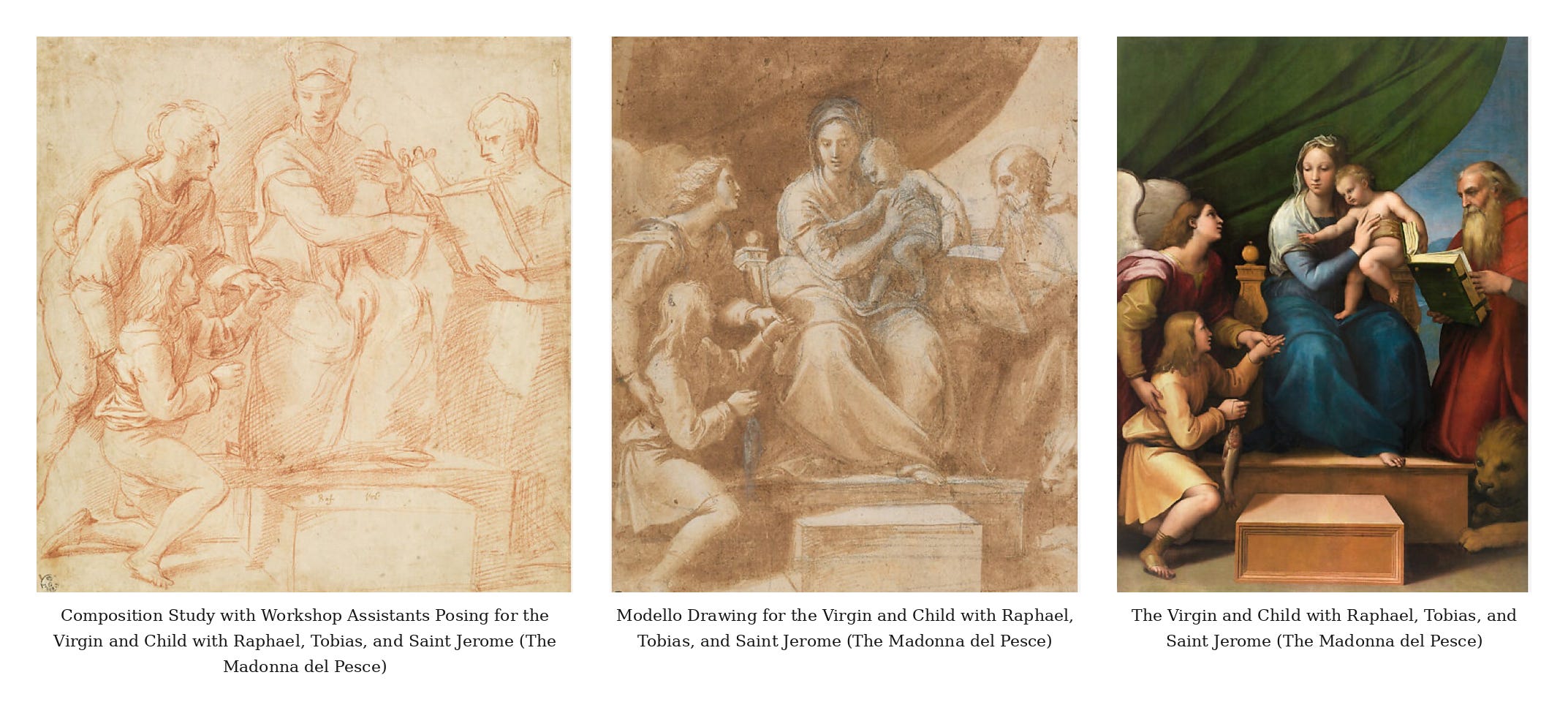
I saw what that training bought in the Madonna del Pesce, where the show reunites the finished altarpiece, lent by the Prado, with two drawings made on the way to it, a composition study from the Uffizi and a more finished design from Edinburgh. In the Uffizi sheet the figures are still being worked out, and a workshop boy in a square cap stands in for the Virgin, holding a shapeless lump where the Christ Child would later go, because no infant was on hand that day to pose. By the later modello drawing the throne has turned, a falling curtain has been added behind, and the composition is nearly the one in the painting. The altarpiece is the third thing in the chain. The price his designs commanded were the return on years of copying and drawing and workshop discipline that taught him which arrangement would hold and which would collapse. The training of the eye, the hand, the judgment, and his taste took years.
That is the problem AI leaves on the table, and copyright was never built to solve it. The taste to know which idea is worth having, the judgment to tell a real one from a plausible one, the years that turn a trained hand into a reliable one, all of it still costs a lot, perhaps less than what it cost Raphael, because of better tools and technology. Even as the expression it produces falls to the price of a few seconds of computing, human capital building takes time.
We will need to figure out how to incentivize effort. How do we motivate people to spend years training their eye and mind? How to pay people for the years that build judgment, so that they still spend them, when the writing those years produce can now be made for almost nothing, is the question AI has actually posed.
The old bargain paid for the first copy when the second was cheap. The new one must pay for the years that teach a person what is worth making.
The current iteration of AI raises the floor, but doesn't proportionally raise the ceiling. On top of that, the amount of human attention has not increased. This means it's still just as hard to get noticed as it was pre-AI (Maybe harder! But a lot that is also due to atomization of distribution channels, which IMO confounds a lot of the current AI debates)
You could generate a million Midjourney images but... who cares? Do they uniquely express something that hasn't been expressed before? Do they stand out? The incentive is still the same: you need to work hard to get noticed, to make your art resonate with people. The one-millionth-and-one same style Midjourney image isn't going to do that.
I do agree there comes an issue is when models become good enough produce great art by themselves with little or no prompting. Good art that resonates. I've been doing a lot of experiments in this space in literature (recently one of my LLM stories garnered praise from other writers https://x.com/jamesjyu/status/2022926490619248883).
One avenue here is that artists can train and cultivate their own models, and then the model itself becomes the expression.
The 'effort' framing is the sharpest way I've seen this put. Most copyright law was written assuming effort and originality move together, and AI breaks that assumption cleanly. The harder question underneath: once effort stops being the proxy for value, what replaces it as the thing worth protecting. Provenance is my answer, but I'm curious what yours is.