


The first time I heard John Coltrane was twenty-five years ago, and I didn’t even realize I was listening to him. He was one of two saxophonists on Kind of Blue, and I couldn’t tell them apart. A few more listens made the difference between Coltrane’s tenor and “Cannonball” Adderley’s alto clear to the ear, though I still knew nothing about either man. Once I could tell the two saxophone sounds apart, I noticed the tenor solos literally took off, and Coltrane’s lack of patience made me very curious about him. I was into a lot of musicians in those years, and few have survived in my collection. Even fewer are the ones I start my day with. Coltrane is the only one I am still trying to understand.
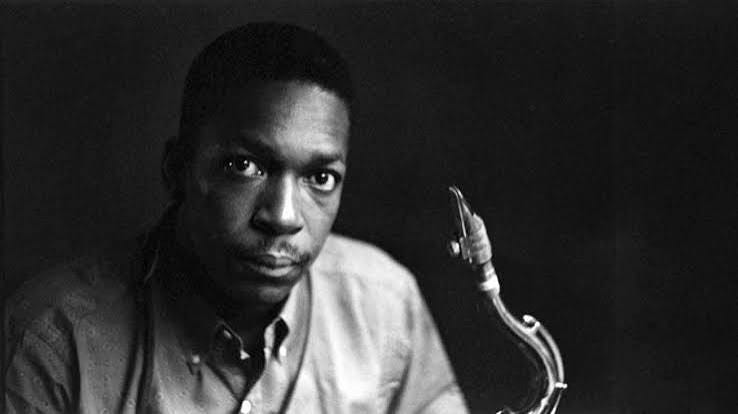
Today, September 23, 2026, is his hundredth birthday on the fall equinox. Everywhere there are Coltrane centenary tribute concerts, and people are talking about him. But I am trying to remember what drew me to him, what continues to draw me to his music, and why this great love continues. And I think it is because I grew up surrounded by Indian classical music. My mother, Vidushi Saraswati Rajagopalan, is a Carnatic veena soloist. And in Coltrane, there is something distinctly Indian about his approach to modal jazz and improvisation. Everyone concedes this is true in the later Coltrane years, but I think it was visible right from the start, and that is what attracted me to him.
This may annoy both jazz and Indian classical connoisseurs. I can almost see someone writing “WHAT ABOUT GIANT STEPS IN 1959” in shouty caps in the comments. “There are no chord changes or progressions in an Indian classical raaga improvisation” might be another. And what is Coltrane without the Coltrane changes? (This is the single best explainer of Giant Steps, Coltrane changes, and the circle of fifths for those who are unfamiliar.)
But I am not setting out to compare two kinds of music or to make a conclusive case. I will leave that to the jazz critics. This is me musing about how I discovered Coltrane and why that might be relevant, for both me and him.
(First) Impressions
When I think back to the years when I discovered him, I pursued Coltrane the way I pursued everything at that age, obsessively. Jazz CDs were still hard to come by in India, and expensive when they turned up, so my friends and I would buy one cassette or CD among us, make copies, and write the track names by hand on the jacket. That was how I got my first copies of Kind of Blue and Giant Steps. Then a friend made me one of these copies of Afro Blue Impressions, recordings from 1963 concerts in Stockholm and Berlin with McCoy Tyner, Jimmy Garrison, and Elvin Jones. The recordings were not released until 1977, a decade after Coltrane died, and they have since become legend. I bought the LPs later, and Afro Blue Impressions, along with a Kind of Blue signed by Jimmy Cobb when I met him in 2014, remains one of my favorite things.
I had heard the studio renditions and standard jazz adaptations of My Favorite Things, but the Berlin version, just over twenty-one minutes long, spoke to me differently. For a long time, I assumed this was because I had grown up on The Sound of Music and loved the original. Coltrane starts with the Rodgers and Hammerstein melody and ends with it, and for the long stretch in between, when he is improvising, Tyner and Garrison hold steady. Now when I look back, I think I related to that rendition, the twenty-one minutes in Berlin, because for long stretches there are no chord changes to work through. He is improvising on the melodic line, discovering the same cluster of notes and playing it differently, again and again, rediscovering how they sound on the way up and down, building his way back to the main melody. That is how Carnatic and Hindustani raagas are explored too, against a reliable drone, with percussion entering in metered sections, and each performance discovers the raaga again. I have listened to this rendition of My Favorite Things hundreds of times, maybe more, and I still find something I don’t remember noticing before.
My Favorite Things
I still love the earlier Coltrane and his chord progressions. Giant Steps and Mr. P.C., his tune for the bassist Paul Chambers, are a splash of cold water to the face every time, and improvising at that tempo takes skill. Yet neither track feels weighed down by the genius or the virtuosity. They sound fresh and fun and new, and they make me want to tap my toes and dance. But the Coltrane that really makes me pause and rediscover is the Coltrane of the modal improvisations in So What and to a lesser extent in Naima.
What is incredible to me is that he was exploring both simultaneously. Kind of Blue and Giant Steps were recorded a few weeks apart in 1959. Giant Steps is the most classic example of chordal jazz, where the main challenge is how to improvise as the harmony moves. Improvising over the progression in Giant Steps, at that tempo, is still the hardest test in jazz. Tommy Flanagan, who played piano on the 1959 session, picked his way through a halting solo, was haunted enough to try it again, and recorded the tune twenty-three years later. Modal jazz is almost the opposite challenge, how to discover a new sound while the harmonic space remains steady.
The chordal Coltrane was looking for more powerful, difficult, and in-your-face harmonic structures, but a raaga improvisation demands a different kind of discipline. The notes are constrained, the pathways between them are very specific, and there are often particular phrases and signatures that can make or break the mood. The experimentation and resolution happen inside those limits, more subtly perhaps, but they can be just as powerful. Some of Coltrane’s modal playing, and later his incantatory use of repetition, feel to me like a move toward that kind of very nuanced intensity.

I am not the first to notice or make the case, but in his later years he was moving toward the latter. But note that ‘earlier’ and ‘later’ are odd descriptions for Coltrane. He picked up a saxophone when he was seventeen and died in 1967, and most of his recordings and compositions are between 1957 and 1967. Still, in the later years, his Indian influences are well documented.
India
Coltrane’s turn toward India was well underway by early 1961, when he was listening closely to Ravi Shankar and collecting his records. That November at the Village Vanguard he played a tune he called India, probably drawn from a Vedic chant on Religious Music of India, a 1952 Folkways record that the bassist Ahmed Abdul-Malik seems to have played for him. On some of the Vanguard performances Abdul-Malik supplied the drone (I am not sure if it was on the tambura or the oud), with Eric Dolphy on bass clarinet and Garvin Bushell on English horn, while on Spiritual Bushell played contrabassoon. The critics at the time were dismissing Coltrane and Dolphy’s music as “anti-jazz.”
Coltrane and Shankar corresponded and eventually met for informal lessons, though published accounts disagree about when they first met. By Shankar’s own account he could teach only the basics of Indian music, which left Coltrane wanting more. Shankar counted him a friend, though he sometimes found his music turbulent. When Coltrane’s second son was born in 1965, John and Alice named him Ravi. Coltrane told an interviewer that Shankar’s music moved him, and that if the two ever recorded together, “I’d increase my possibilities tenfold.” The two never recorded together, yet Shankar later recalled that Coltrane planned to set aside six months in 1967 to study at his school in Los Angeles.
Did Coltrane find himself attracted to Ravi Shankar because he was already on this journey? Carl Clements, an ethnomusicologist, would say yes. He argues that once the modal approach of the late 1950s loosened Coltrane’s dependence on chord changes, he went looking for other kinds of structure and found them in Indian scales. Coltrane’s saxophone student Carl Grubbs, a cousin of his first wife Naima, noticed a page of these scales at Coltrane’s house in Queens and made his own copy, which Lewis Porter later reproduced in his biography. Beside each of the six scales on Grubbs’s copy is a time of day, and some carry a mood as well. One is marked as a sad morning scale and another as a night scale of power and majesty. Clements identifies the sad morning scale as Bhairavi (the Hindustani Bhairavi, not the Carnatic one), whose notation on Grubbs’s copy leaves Pa out on the way up and restores it on the way down, and he reads this, along with the labels of hour and mood, as evidence that Coltrane understood a raaga to be more than its scale. Two more pages in Coltrane’s own hand, reproduced in Cuthbert Simpkins’s 1975 biography, list eighteen scales from around the world under names like Arabian and Balinese, and three of them have Indian names. One can find notes that suggest he was looking at Malkauns, Charukesi, and Todi.
Coltrane told a Dutch interviewer in 1961 that the Indian elements in My Favorite Things had been “more or less subconscious,” and Clements finds little literal use of raagas in the music, though Coltrane kept returning to Indian ideas about music acting on the listener and on the world. He told Nat Hentoff he had been studying approaches to music, as in India, where particular sounds and scales are meant to produce particular emotions.
In an interview published in 1963, he told Jean Clouzet and Michel Delorme that he wished he could find a way to make it rain when he wanted, or play a song that would cure a sick friend or bring a broke one money, and admitted he did not know which pieces would do it or how to learn them. The wish reminds me of the old stories of the great Mian Tansen singing raag Deepak and setting the lamps alight, and of Bhimsen Joshi singing raag Megh Malhar to invoke the torrential Mumbai monsoon.
Coltrane was already permuting small groups of notes when he played with Thelonious Monk in 1957, and Miles Davis described him taking five notes of a chord and turning them around to hear how many ways they could sound. Clements compares this to the permutational procedures of Vedic recitation, though there is no evidence that Coltrane learned the technique from India. He was simultaneously exploring many different spiritual traditions.
A Love Supreme
What would Coltrane explore had he lived longer? Coltrane told a press conference in Japan in 1966 that in ten years he would like to be a saint, and he was far along his spiritual journey by then. He died the following July, at forty, and never had those ten years. My hunch, and this is the controversial part, is that despite the clear Hindustani influence, he would have spent some of them conquering the Carnatic melakarta system.
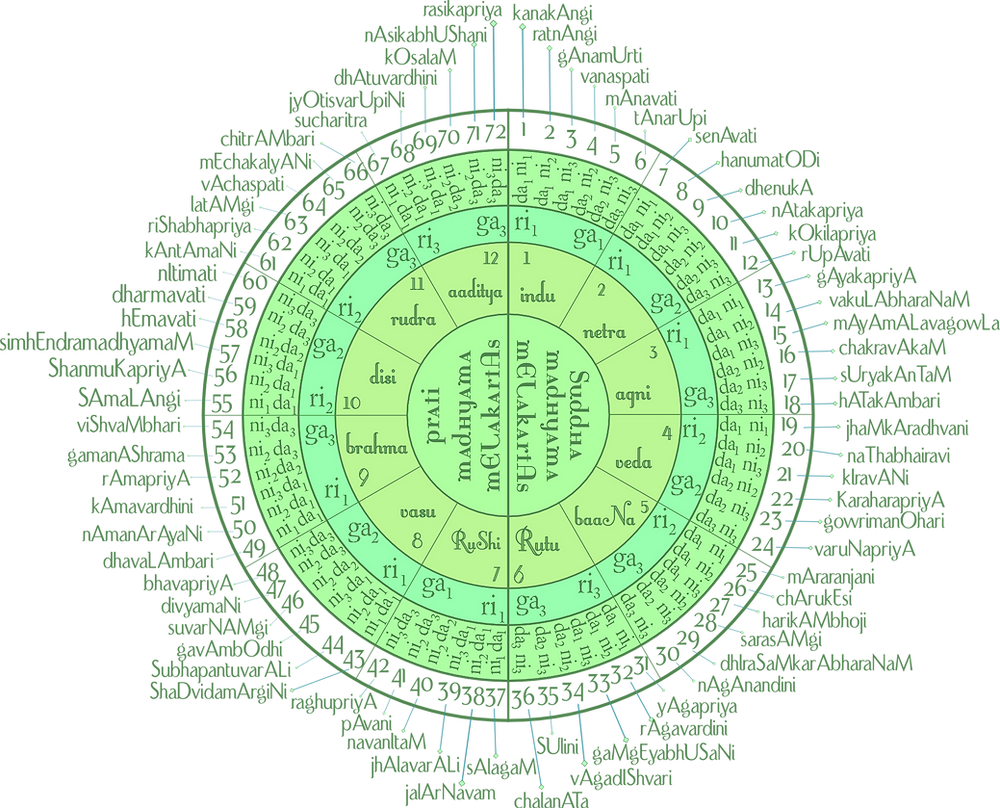
The melakarta system has exactly 72 parent scales. Venkatamakhin set out the 72 possible melas in the Chaturdandi Prakasika around 1660 and wrote that not even Shiva could produce a seventy-third. He was right, though only because he had fixed the rules so that the arithmetic produced exactly 72.
The octave has seven swaras, Sa Ri Ga Ma Pa Dha Ni, and of these Sa and Pa do not move while Ma has two positions. Ri and Ga each have three positions, but Ga must sit above Ri, which leaves six lawful pairs, and Dha and Ni are held to the same rule for six more. Multiply the six pairs below Pa by the six above it and by the two positions of Ma, and you get 72.
Melakarta means the maker of melas, the scale that makes other scales, and every raaga in the system is filed under one of them. Govindacharya eventually converted this into the modern-day sampurna melakarta system with standardized names. The 72 sit in twelve chakras of six. The chakras have names, Indu, Netra, Agni, Veda, Bana, Rutu, Rishi, Vasu, Brahma, Disi, Rudra, Aditya, and the names are a count in disguise. Indu is the one moon, Netra the two eyes, Agni the three fires, Veda the four, and so on to the twelve Adityas. Here is an interactive chart you can play with to understand the system.
The raaga names are a count in disguise too. The 72 names that Govindacharya gave are still in use and built them on the katapayadi system, in which consonants stand for digits. Take the first two consonants, read them as numbers, reverse them, and you have the raaga’s position. Kharaharapriya is kha 2 and ra 2, so 22. Mechakalyani gives me 5 and cha 6, which reversed is 65, and Hanumatodi gives ha 8 and nu 0, which reversed is 8. A musician who knows a melakarta’s name knows its scale, its chakra, and its Ma without looking anything up.
I think Coltrane would have made it his mission to master all 72 parent raagas. This was a man who practiced out of Nicolas Slonimsky’s Thesaurus of Scales and Melodic Patterns. He rehearsed in the breaks between sets in the men’s room. He often played 18 hours a day. And I think he would have attacked this new system with the same level of dedication and obsession that he displayed throughout his career, and eventually improvised in each of the 72 scales and written new raagas in them.
But it is not just the technical skill or virtuosity required to master the melakarta system that I think would have drawn Coltrane. A raaga is made by the particular pathways through its notes, by the phrases and signatures that give it its character, and small changes in the way those notes rise and fall can completely change the mood, or rasa. The idea of rasa goes back to Bharata’s Natyashastra, which names eight: shringara for love, hasya for laughter, karuna for sorrow, raudra for anger, veera for courage, bhayanaka for fear, bibhatsa for disgust and adbhuta for wonder. Later thinkers, most famously Abhinavagupta, added a ninth, shanta, the rasa of peace, and together they became the navarasa. Carnatic musicians tend to attach these moods to raagas. And each raaga can have more than one rasa, more than one emotion or mood, depending on how it is rendered. Mohanam, one of the first raagas a student learns, is filed under shringara, hasya, adbhuta, or veera depending on the melody and rendition. That idea, that the smallest changes within a strict musical grammar can alter the emotional world of a piece, seems to me exactly the sort of problem Coltrane would have wanted to spend years exploring.
As long as we are engaging in wishes, another one is Coltrane playing with Nusrat Fateh Ali Khan. I think the obsessive quality of recitation and repetition in Nusrat’s qawwali, the long improvisations, the slow-building crescendos, and the eventual arrival at something close to ecstasy would have appealed enormously to Coltrane. In fact, I feel he was searching for something like that sound in A Love Supreme and the quest becomes a little clearer in the recently discovered Seattle recordings. There is something in the repeated invocation of the phrase itself, and in the turbulence of Resolution and Pursuance, that feels as though he is trying to reach a state beyond improvisation, where repetition and intensity become a form of spiritual transport. He finds some resolution in Psalm, but I think exposure to the Jalandhar-Faisalabad qawwali tradition, where a phrase can be repeated, worried at, teased, and intensified until it becomes almost incantatory, might have nudged him further along that journey, to find it in his own way. That would have been an incredible collaboration. We lost Nusrat too young, and I don’t know if he ever heard Coltrane, but I would have loved to hear what the two of them might have found in each other’s music.
These are not exactly predictions, but wishes. And finally, a hope that another one like Coltrane will come along and build the bridge between my two loves, jazz and Carnatic classical. In modal improvisations, the closest successor to Coltrane is Joe Lovano. On learning and improvising within the strictures of a raaga, John McLaughlin comes to mind. One day, others will pick up this thread and merge these traditions to create yet another sound. Until then, we have Coltrane.
Ravi Shankar influenced—and befriended—three very different Western musicians: John Coltrane, George Harrison, and Philip Glass. Hard to think of someone who has influenced such disparate genres.
Wow, thank you! Literally my all time favorite essay. If you haven't, Chasin' the Trane by J.C. Thomas is must read. Read three times when I was 13, life changing.