


West Bengal’s new government says it wants to revive industry and attract investment. The first challenge is whether investors can easily access land in a state where almost two-thirds of the land is still defined as cultivable land. Although agriculture need not completely disappear, industrial expansion will require shifting land from agricultural to industrial and other non-agricultural uses. Especially when in the middle of high economic growth and structural transformation, landowners choose to sell, and buyers put it to a more valuable use.
A firm that wants to build a cold-storage warehouse for farm produce may need to convert agricultural land. It would look for a plot near farms, with good road access to towns and markets. Suppose it identifies such a plot in West Bengal, the landowner is willing to sell, and both agree on a price. That is only the beginning of what will seem like a game of Gyan Chaupar, but with without the moral education.
In this the predecessor to Snakes and Ladders, the firm begins at square 1 with the willing seller and agreed upon price. The firm’s goal is square 36, where it has acquired the land to build the warehouse. Along the way, the firm must navigate controls on how it can change the land’s use, how much it can own, and what it can build. It must also figure out whether an exemption offers a ladder past any of these controls. Even completing the sale may not put the firm beyond the snakes because someone who successfully exercises a right of pre-emption can replace the firm, sending it back to square 1.
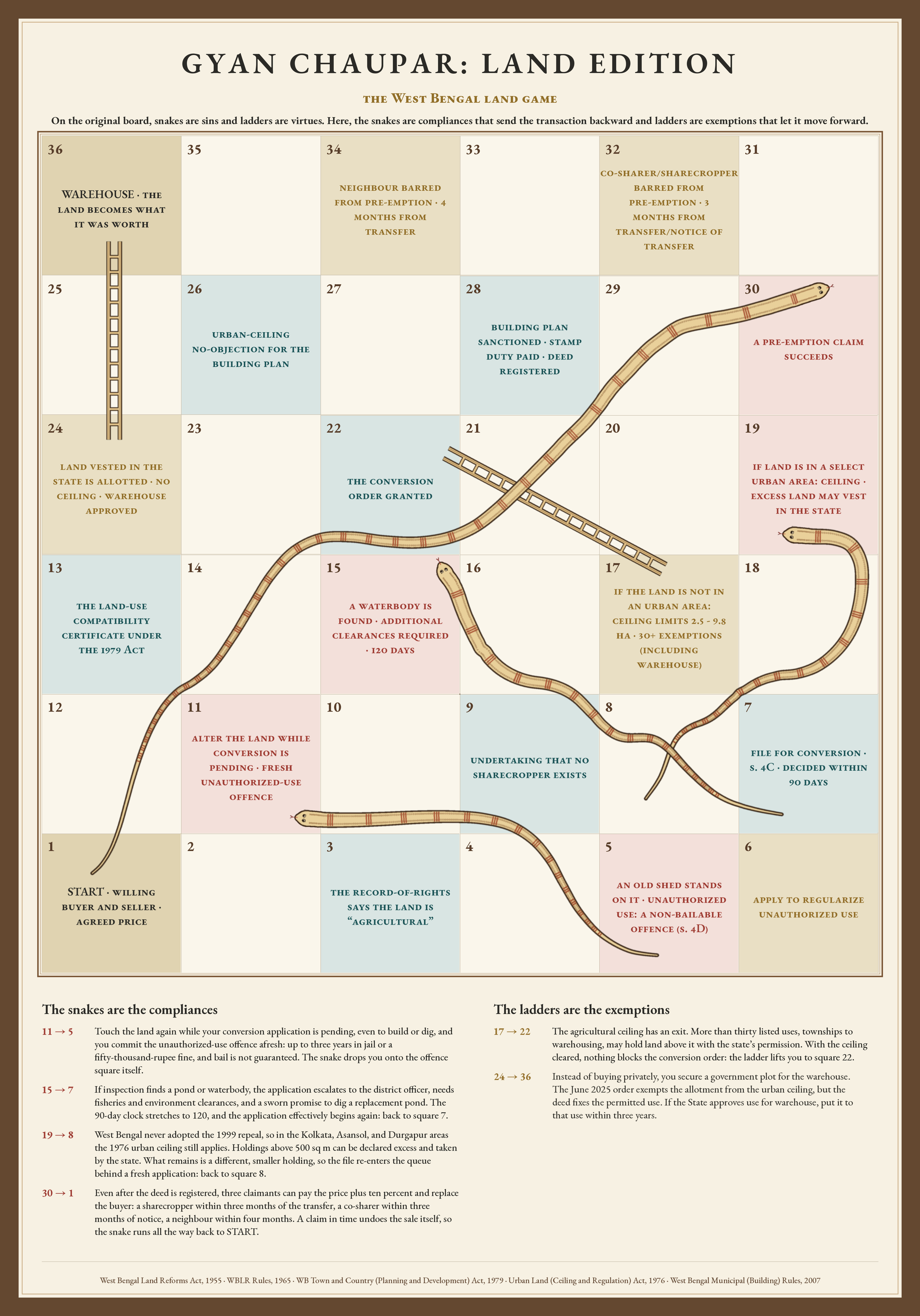
Confused? Wondering what this whole land-use conversion business is? What pre-emption even means, or why one permission only affords you a chance to ask for another? If you are overwhelmed by this, we understand. But if you are curious about how these rules work, or how much the new government would have to change before it can welcome investors and mean it, read on.
Land conversion
Say the firm found a 700 sq m plot in Baidyabati, Hooghly, to set up its cold-storage warehouse. The plot belongs to a typical Bengali family from the seventies – say three siblings who inherited equal, undivided shares in it from their father, Mr. Das. On the farm, Das had also built a shed to run a small workshop repairing irrigation pumps benefitting the agricultural community around them. The location suits the firm, and the siblings are keen to sell.
But the firm discovers that the record of rights classifies the plot as agricultural land, and that Das never obtained permission to change its use to include the repair shed under the West Bengal Land Reforms Act, 1955, as amended over the years. Such unauthorized change of use is an offense under the Act, for which the police can arrest without a warrant, bail is not guaranteed, and conviction carries up to three years’ imprisonment or a fine of up to 50,000 rupees, or both.
To avoid any prosecution, the siblings apply to regularize the alteration, under a provision added in 2017.[1] A state bureaucrat must then decide whether regularization is necessary in the public interest. Even if the state grants it, that will not authorize any new use, and neither the siblings nor the firm may build the warehouse until the state permits the non-agricultural use under section 4C of the West Bengal Land Reforms Act.
The conversion application goes to the Sub-Divisional Land and Land Reforms Officer under Rule 5A of the West Bengal Land Reforms Rules, 1965, and the siblings, as recorded landholders, must file jointly. They must also show that no sharecropper, a bargadar, exists on the plot. Bengal’s tenancy regime for agricultural land recognizes sharecropping arrangements in which the cultivator pays the owner a share of the crop and acquires permanent, heritable rights to till the land. What the law withholds from owners of agricultural land is the ordinary market instrument, a recorded fixed-term lease under which the tenant pays rent, the term ends, and the land returns to the owner without creating cultivation rights.[2] On this count the Das siblings are lucky. Their father never leased the land, fearing that a temporary arrangement would lead to a permanent claim. In practice, this means they didn’t have to trace every sharecropper to sign a no-objection certificate to the sale or change in land use. Most others can’t bypass that step.
Next, the siblings need a land-use compatibility certificate from the planning authority (Kolkata Metropolitan Development Authority for Baidyabati), certifying that a warehouse fits the development plan for that stretch of Baidyabati under the West Bengal Town and Country (Planning and Development) Act, 1979. If the plan already permits warehousing, the state has answered the substantive land-use question. The siblings must still complete the separate section 4C process. In its manual for officers of the Land and Land Reforms Department, the government concedes that the two authorities decide “substantially the same issue.” Instead of eliminating one of these processes, the manual directs the two to consult each other before passing orders.
During conversion, the revenue officer must confirm that the new use will not interfere with farming on adjoining plots or with any public easement. The officer must make a final decision on the conversion within 90 days of filing the application. If the plot contains a waterbody, the application moves up a rung to the District Land and Land Reforms Officer, requires two more clearances from the state’s fisheries department and environment department, and the 90-day timeline stretches to 120 days. If the officers do not meet these timelines, they can explain away the delay with written reasons.
Land ceiling
Permission to change the use still does not permit construction. Building a structure requires a sanctioned plan from the Baidyabati municipality under the West Bengal Municipal (Building) Rules, 2007. Under those rules, the building application must include a no-objection certificate from the competent authority administering urban land ceilings. As it happens, the Das plot is also governed by one, which most of India repealed a generation ago.
West Bengal still enforces the Urban Land (Ceiling and Regulation) Act, 1976, which limits how much vacant land a person may hold in Kolkata, Asansol, and Durgapur urban areas; where the land exceeds the ceiling, the state takes the excess. Parliament passed the repeal in 1999 after the ceiling had choked urban land supply, raised housing costs, and created a permission market around exemptions. But the repeal takes effect only in states that adopt it, and West Bengal is among the few that didn’t.
Baidyabati is expressly included in the Kolkata urban agglomeration covered by the Act, where the ceiling is 500 sq m. The Das siblings, however, do not cross that ceiling merely because they jointly own a 700 sq m plot, as their undivided shares are counted separately.[3] But the firm wants to buy the whole plot, 200 sq meters over the limit.
But that does not automatically make 200 sq m excess land. The authority must first determine how much of the plot qualifies as vacant land under the Act and what other qualifying land the firm already holds. If the purchase puts the firm above the ceiling, the excess can ultimately vest in the state, leaving the firm with less land than it paid and planned for. To circumvent this, the firm can file yet another application for an exemption.[4] The state government may (or may not) grant it if it considers this in the public interest or finds that enforcing the ceiling would cause “undue hardship” to the firm.
Preemptors or Tormentors?
Suppose all authorities grant the permissions, the sale concludes, and the deed is registered. Section 8 of the 1955 Act still hangs over the transaction. After a registered sale, a co-sharer holding an undivided share, an adjoining landowner, or a sharecropper can go to the local civil court, deposit the price plus ten percent, and ask the court to substitute the claimant for the buyer. The buyer gets his money back with the ten percent premium, but he loses the land he bought in good faith. You’d be surprised how often preemptors exercise this option after a sale has concluded.[5]
Courts in West Bengal still hear claims like these, and some even reach the Supreme Court.[6] If they fail, it is because the claimants either did not file the application or did not pay the full deposit. While the courts have contained the worst procedural lapses, section 8 still survives.
If one of the three siblings stays out of the sale, that sibling remains a co-sharer and has three months from when he receives a notice of the sale to make the preemption claim. A neighbor who owns the adjoining plot can also exercise this pre-emption right, within four months from when the sale occurs. This right may keep agricultural land from passing to outsiders, but in practice, it keeps registered deeds in West Bengal provisional, often for decades, when claimants surface saying they only just learned of the sale.
HaJaBaRaLa (Habber-Jabber-Law) [7]
If this seems like just a problem of small plots in urban areas, it is even worse for a developer assembling agricultural land for a logistics hub, food park, or township. Chapter IIB of the 1955 Act caps agricultural holdings at 2.5 hectares for an individual on irrigated land and up to 9.8 hectares for the largest families on non-irrigated land. While the ceiling limits landholdings from above, inheritance splits them from below. And Bengal’s average operational holding has fallen to about 0.76 hectares, a fraction of even the lowest cap. Anyone setting up a project at scale has to negotiate with dozens or hundreds of small owners, each with heirs, record entries, possible sharecropper claims, pre-emption risk, and a separate conversion path. The transaction costs and holdout problems make assembling a large parcel nearly impossible.
The government knows this, which is why it has amended the ceiling-permission route at least four times since 1996 and created exemptions, instead of repealing the ceiling. So, tea gardens, mills, factories, workshops, livestock breeding farms, poultry, dairy, townships, transport terminals, logistics hubs, fisheries, educational and medical institutions, oil-and-gas pipelines, mining, biotech parks, and food parks may hold land above the ceiling with permission. The list reads as a census of the state’s most influential interest groups and favorite projects.
This is how land moves in West Bengal, through permission, exemption, and discretion, with rents paid along the way, and rarely through voluntary transactions between willing buyers and willing sellers. The system works for groups that can negotiate with the administration. It fails the firm that wants three contiguous plots for a warehouse, the landowner who wants to pool land with a neighbor for a poultry unit, and the household that wants a clean lease for solar panels. Each exemption empowers the office that grants it and moves one more transaction out of the market.
The latest turn in this cycle of interventions came in June 2025, when West Bengal exempted land the state itself allots to private parties from the urban ceiling. Even this exemption binds allottees to use the land only for the purpose which the state approves (unless they go through the process of securing permission for a different use!) and to do so within three years.
When exemptions fail and private assembly cannot reach scale, the state acquires the land and calls objecting farmers anti-development, as it did in Singur for the Tata Nano plant, an acquisition which the Supreme Court struck down in 2016 after a decade of political and administrative damage. Compulsory acquisition and discretionary exemption are first-order consequences of the same restriction which prevents markets from assembling land, so the state assembles it by coercion or releases it by favor.
Put all the required permits and paperwork together and Sukumar Ray’s poem Ekushe Ain (The Law of Twenty-One) comes back to mind: “There, before six in the evening, you need a ticket (permission) to sneeze.”.
West Bengal has admitted the problem in every permission, carve-out, notification, and exemption it has issued. Land in the state is trapped, and the government releases it selectively to chosen users for chosen uses. And yet, in one of its very first announcements, the new government proposed that it would purchase land under its direct land purchase policy and hand it to investors.
Without reform, West Bengal has struggled and will continue to struggle to get industry, housing, or new urban centers, because land stays locked inside rules that make private assembly nearly impossible. And policy changes must also go beyond bureaucratic modernization that digitizes records and layers e-portals and dashboards over the same constraints. Serious reform would confine the state to protecting titles and enforcing contracts, and leave sale, lease, pooling, mortgage, and change of use to the people who own the land.
Other states have been chipping away at the same regulatory morass, particularly land-use conversion. When Telangana eased its land-use conversion regime in 2015, built-up land on the Telangana side of the new border grew about 1.3 times faster than on the Andhra side. Andhra Pradesh then repealed its conversion law altogether in 2025, accepting that development authorities already oversee land use and no separate process is needed. Maharashtra removed the collector’s separate conversion permission where the development or regional plan already permits the proposed use. Uttar Pradesh now deems an approved building plan or development permission as a change of land use in notified areas.
We hope West Bengal starts there.
[1] Under Section 4C, as amended, the state can regularize plots of any size, other than waterbodies, if it considers regularization necessary in the public interest. The government limited applications to changes made before November 7, 2017. The last extension allowed to such applications was March 31, 2026.
[2] A separate law, the West Bengal Non-Agricultural Tenancy Act, 1949, governs tenancy in non-agricultural land and recognizes fixed-term leases.
[3] For ceiling purposes, the siblings’ undivided shares are counted separately; Pratima Paul vs Competent Authority; Maharao Sahib Sri Bhim Singhji vs Union of India.
[4] Section 20, the Urban Land (Ceiling and Regulation) Act, 1976.
[5] Section 8 has generated court battles over everything from deposits to the meaning of “portion or share”: Chhana Rani Saha, Naymul Haque, Dilip Kumar Dhara, Barasat Eye Hospital, Abdul Matin Mallick, Kishan Kumar Sureka, Rafikul Sk, Bholanath Dinda, Sk. Abdul Odud Ali, and more.
[6] Gopal Sardar spent nearly two decades in court defending a purchase against a claim that was ultimately dismissed as too late. In Sib Nath Chatterjee, it took another seven years after the High Court’s dismissal for the Supreme Court to reach the same conclusion.
[7] The title of Sukumar Ray’s Bengali novella which is a nonsense tale of increasingly bewildering encounters including an absurd trial. The English version, translated by Arunava Sinha, is titled Habber-Jabber-Law.
Shruti, Shreyas, totally an aside, but the inclusion of the Snakes and Ladders game was so creative. Said OOH for 5 seconds twice after looking at it :P Thank you for this edition!
A nice deep dive into a wtf policy